Trans-European Dialogue 2027

EAPAA 25 Years of Dialogue on Public Administration Accreditation

Diogo Pereira,

This year, we are celebrating 25 years of cooperation and dialogue on Public Administration Accreditation in Europe and we have invited Theo van der Krogt, former EAPAA secretary, and Geert Bouckaert, the first EAPAA chairman, to write some words about this remarkable journey and the significant milestones achieved along the way.

Theo van der Krogt recalls the inception of EAPAA at the EGPA 1999 conference, where Prof. Huib de Jong initiated discussions on establishing quality standards for European public administration programs. This initiative, strongly supported by EGPA and NISPACee, led to the formation of EAPAA under Dutch law, with Geert Bouckaert as the first chairman. 

Geert Bouckaert reflects on the two major streams that made the establishment of EAPAA a logical decision at the turn of the century: the evolving role of the public sector and the need to enhance the quality of teaching university programs. He emphasizes the European nature of EAPAA’s accreditation culture, which respects the diversity of administrative cultures and promotes a networked peer review model.

To read the full contributions from Theo van der Krogt and Geert Bouckaert, please click on the link below.


About EAPAA

The European Association for Public Administration Accreditation (EAPAA) is an autonomous organisation that aims to develop and maintain a system for the voluntary accreditation of academic public administration programmes in higher education. Since 1999, it has evaluated programmes in a wide variety of countries.

The European Group for Public Administration (EGPA) and the Network of Institutes and Schools of Public Administration in Central and Eastern Europe (NISPAcee) are the two official members of the institution, who jointly appoint members to the EAPAA board.

Resources

Public administration and management research has long drawn most of its ideas from Western, industrialised democracies. Yet Asia and the Global South have become major sites of administrative change, with large-scale reforms, fast-moving technology and some of the most inventive experiments in governance. Research from these regions has grown accordingly, but it is still often used to illustrate or apply theories made elsewhere, rather than to produce new ones.

This special issue of Public Management Review aims to change that. It invites authors to treat practice in Asia and the Global South as a starting point for theory: to test, question or extend established approaches, and to propose new concepts and explanations. It does not look for a single theory of these regions, which are far too diverse for that, but for context-sensitive contributions that also say something useful for policy and practice.
ASPA and EGPA call for papers | New Orleans, April 12-13, 2027 | Deadline: November 30, 2026

As democratic institutions face mounting pressure worldwide, public administrators are increasingly asked to spell out the role of their field in protecting and improving democratic systems. The American Society for Public Administration (ASPA) and the European Group for Public Administration (EGPA) are responding with the 2027 Transatlantic Dialogue (TAD), held alongside ASPA’s Annual Conference.

The theme is The Role of Public Policy and Administration in Shaping Democracy and Promoting the Resilience of Democratic Norms and Institutions.

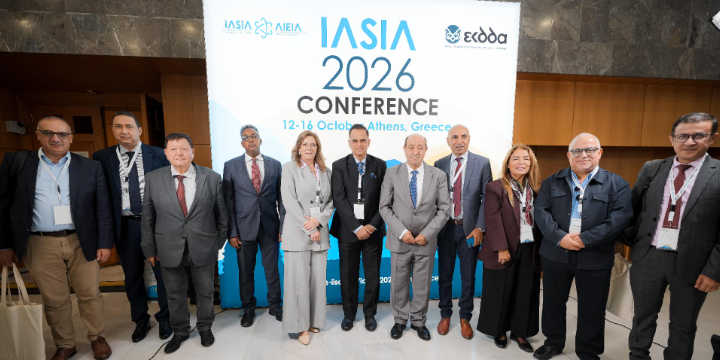
From 12 to 16 October 2026, the International Association of Schools and Institutes of Administration (IASIA) held its Annual Conference in Athens, hosted by EKDDA, the National Centre for Public Administration and Local Government. Under the theme “Rethinking Governance for a Changing World”, the conference gathered 400 delegates from 57 countries and marked the 65th anniversary of the association. Athens was a conference grounded by learning and history but also new projects and connexions.

Modify cookies